

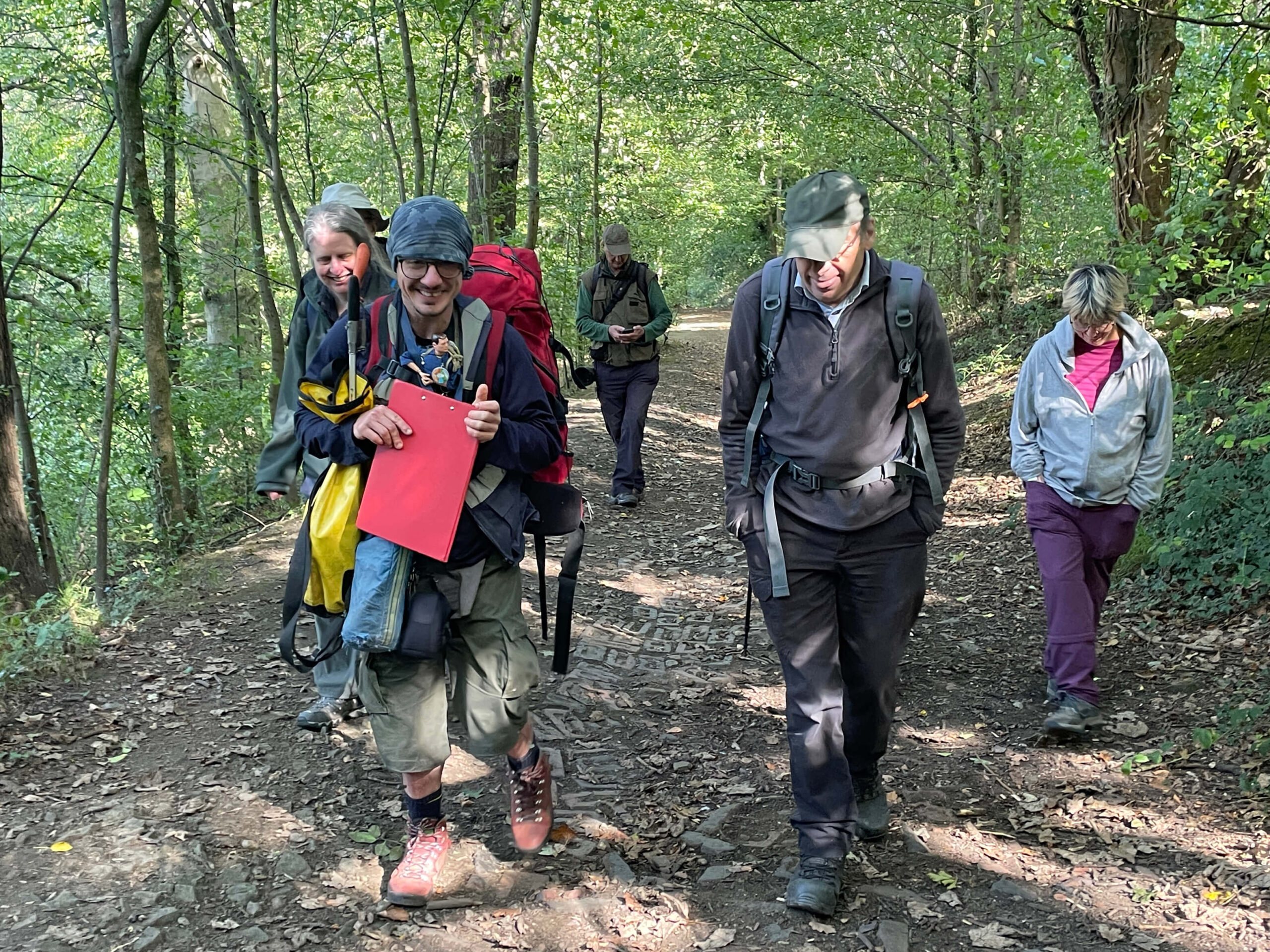
On a bright and sunny early autumn afternoon, the Gleadless Valley Wildlife Trust led a community walk through Carr and Lees Hall Woods. We set off along the footpath leading from where Lees Hall and Thorpe House Avenues meet. The theme of this walk was to explore the ecology and landscape history of these ancient woodlands.
Both woodlands are included within the scope of the InNature project. In Carr Wood the focus will be on the restoration of a relic hazel coppice with the help of community volunteers. This will provide multiple benefits: increased biodiversity; community participation in greenspace management; and the transfer of traditional coppicing skills to a new generation of nature custodians.
In Lees Hall Wood the work will be centred on the footpath network around Lees Hall Farm pond. The footpath surface on this part of Cat Lane is affected by seasonal flooding. This will be improved and better drainage installed. Enabling easier access through the woodland and encouraging more people to use this central route through the Gleadless Valley.
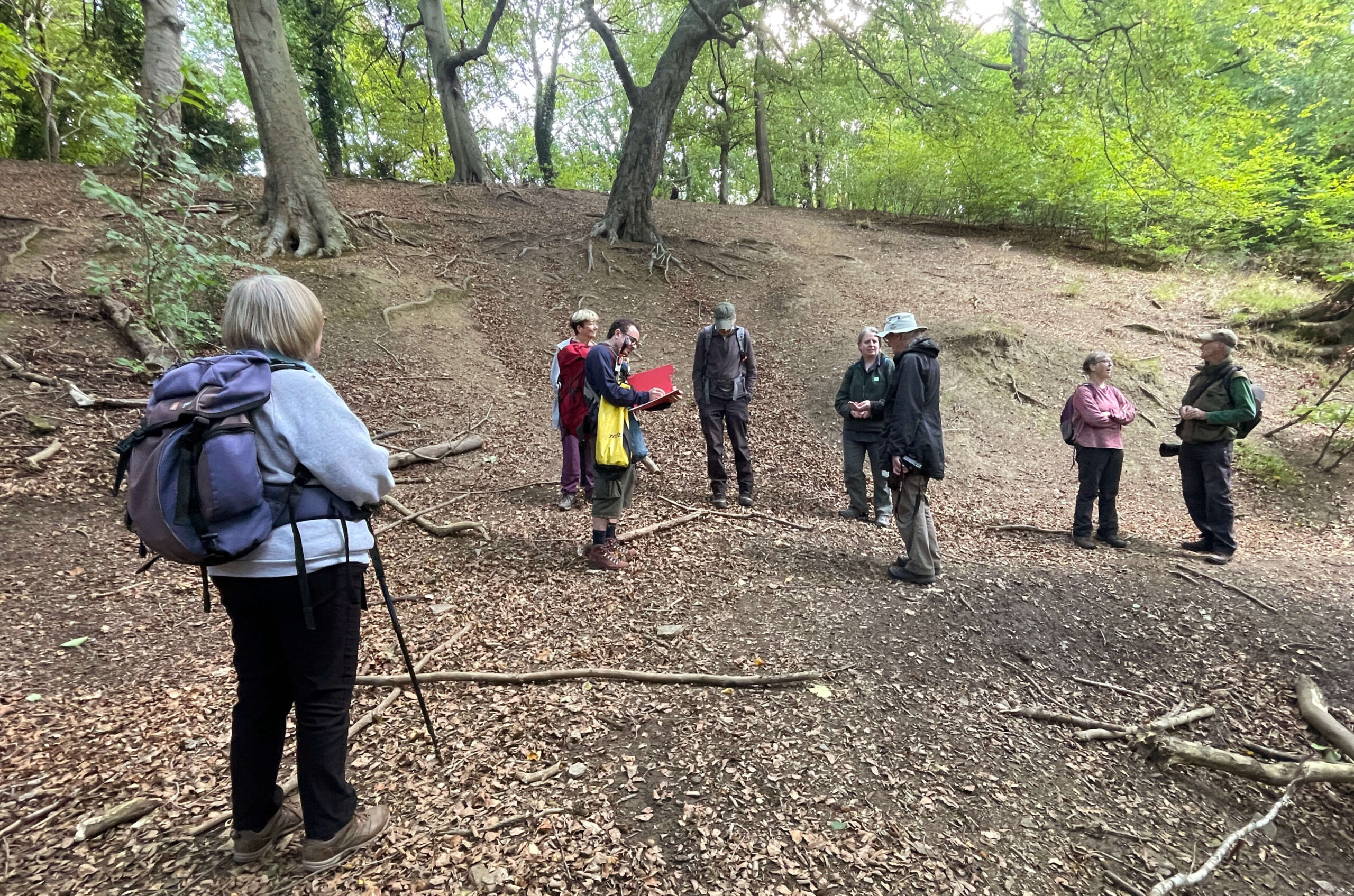
From the 1600’s onwards, Carr Wood was managed as a coppice. The hazel was cut on a 30 year cycle to provide poles aka ‘small wood’ for a number of uses, including making charcoal. This traditional management of Carr Wood ended in the mid-1800s, when the need for small wood declined in favour of using larger timber. Around this time sycamore was planted within the hazel coppice. Because it burns at a higher temperature than many timbers, sycamore was used for cleaning the furnaces of industrial Sheffield.
Left unmanaged, these large sycamores cast shade on the hazel and, because hazels need light to thrive, some parts of the coppice are in a poor state. Even on a sunny day, the light reaching the hazel understory was minimal. Removing a selection of the sycamore trees will allow natural regeneration to take place. Hazels will be carefully recoppiced to rejuvenate them and prolong their life. Cutting them back hard causes them to regrow with renewed vigour.
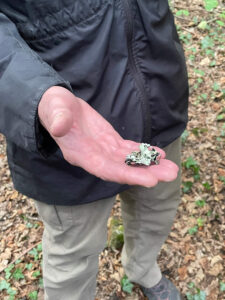
A short distance from the coppice, a powdered ruffled lichen Parmotrema arnoldii was found. Although this foliose lichen is a common species worldwide, it never used to be present in the Gleadless Valley. Like many lichens, it is sensitive to pollution and the fact that it is now observed here is a positive sign of the general health of the ecosystem.
Evidence of a possible charcoal hearth, where hazel was turned into the charcoal to be used in local furnaces, was discovered within the coppice. Unfortunately they are not only hard to see but they are especially hard to photograph. It was a case of using our imagination to trace the outline of the hearth among the tree roots and fallen leaves.
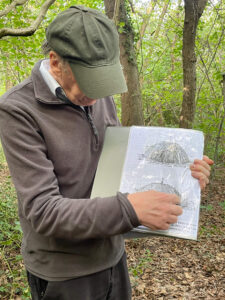
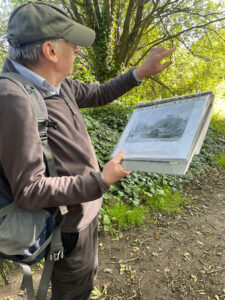
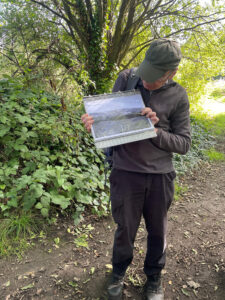
Luckily enough we had an illustration to refer to that shows how the hearths were constructed. First a dome was created using poles, which was then covered in turf stripped from the woodland floor. The turf cover ensured that it was airtight, allowing a controlled burn to take place over multiple days. The unfortunate consequence of turf stripping is lost groundflora habitat. At another InNature site, in Rollestone Wood, we will slow down soil erosion and allow deeper soils to form on a slope where turf was removed historically.
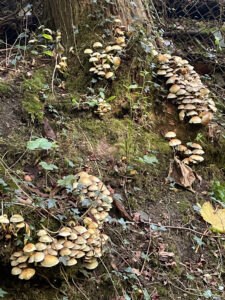
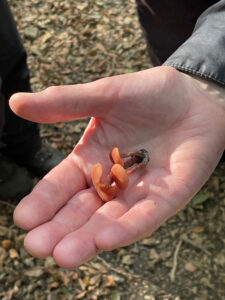
Because this was an autumnal walk, it was a good opportunity to see some of the local fungi species. Five species were identified; four of which are common, one which is less so. First, we came across a large colony of sulphur tuft fungus Hypholoma fasciculare, growing on the damp banks of the Meers Brook. This is an easy fungus to identify on account of the bright yellow colour and the slimy cap texture when moist. The next one we found was the deceiver Laccaria laccata, an unassuming tan to pale terracotta fungus. The key to identifying this one is the uniform colour throughout the cap, the gills and the stem. Although edible when cooked, they have a strong earthy taste much like the smell of the humus rich woodland soil they grow in.
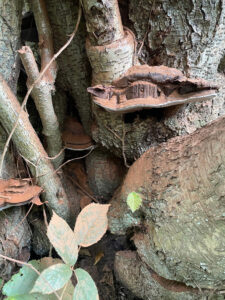
The oldest hazel coppice in the woods, judged to be hundreds of years old, is slowly being consumed by a Ganoderma fungus. These bracket fungi decompose the tree’s tough heartwood. This part of a tree is not alive and serves no purpose other than to stabilise the trunk. Bracket fungi are common on veteran and ancient trees, where they release nutrients held inside the heartwood and return them to the soil. This Ganoderma had recently dropped its spores, dusting everything reddish-brown. The plan is take some of the larger, heavier limbs off this historic hazel, to prevent it from splitting open.
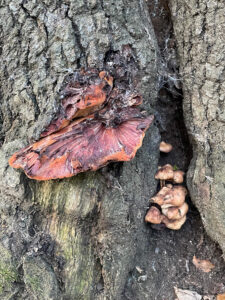
Less commonly seen is the beefsteak fungus Fistulina hepatica, the remains of which was found growing on the base of an oak at the side of Cat Lane (the old farm track). This bracket fungus is readily distinguished by its red colour and the blood-like liquid that oozes out when cut. Another edible species, this one had clearly been foraged some time earlier. Spindle toughshank Gymnopus fusipes was seen growing in a crevice just below the beefsteak. This is a necrotrophic parasite that favours oak and beech trees, causing root rot and the eventual death of its host.
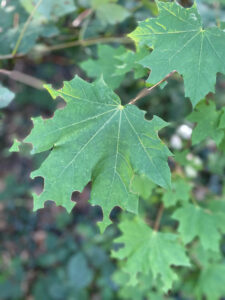
Another interesting and unexpected find was a Norway maple Acer platanoides sapling where the leaves had been eaten by leaf cutter bees Megachile spp. The bees have done this corner of the Gleadless Valley a small favour: Norway maple is invasive. Much like sycamore, these tall and relatively fast growing trees have large leaves that shade out native species trying to grow beneath them.
A little uphill from the old gateposts marking the entrance to the long demolished Lees Hall Farm, we stopped to take in what remains of the agricultural landscape. This is where Cat Lane passes the restored Lees Hall Farm Pond, the section of the track where there is frequent seasonal flooding. We were shown an illustration, dating from the 19th century, of the farm buildings on which the location of the farm pond could be made out. We were also presented with a view of the fields around the Gleadless Valley photographed 1955. Taken shortly before the land was acquired by Sheffield City Council and developed into the Gleadless Valley housing estate.
The farm existed well into the 20th century but it is now only a shadow of itself, with just a few building foundations still visible. If not for the pond, and the adjacent relic farm orchard, it would be all but impossible to orient oneself in relation to these missing features.
If you want to learn more about Regather’s InNature work, read the previous blog here.
Funded by the European Union Horizon Europe Research and Innovation Programme under grant agreement 101181560.